Easter Traditions in Podhale: Where Faith Meets Mountain Folklore
Planning an Easter getaway to Podhale, one might easily feel lost among rituals that are as impenetrable to an outside observer as the thick Tatra mist. Few realize that as recently as the 1960s, Highlanders (Górale) would solemnly bid farewell to winter on the mid-Lent Sundayby drowning the “Śmiertka”—a straw effigy symbolizing approaching death.
From "Śmiertka" to "Bazicki": Easter Traditions in Podhale
The period of preparation for the holidays in the mountains has always been a rigorous time, yet one filled with deep meaning. For Highland farmers, these ancient customs are more than just history—they are the foundation that still defines the atmosphere of Podhale villages today. Easter traditions here begin long before the first star appears, and their rhythm was once dictated by nature itself.
The old, strict fast could test even the toughest Highlanders. According to some sources, breakfast often consisted of nothing more than a single slice of dry bread and a cup of bitter coffee (Source: zakopane-apartamenty.pl).
Mid-Lent and the Symbolic Farewell to Winter
In the past, midway through Lent, one could encounter colorful and somewhat mysterious processions on Podhale roads. Youth and children would solemnly carry the “Śmiertka”—a straw doll dressed in women’s clothing—out of the village. She was the symbol of winter and all evil that had to be discarded to make room for new life.
The tradition of walking with the “Śmiertka”, was practiced in Podhale until the 1960s (Source: krainasmaku.com). The effigy was either drowned in a stream or burned to definitively end the reign of frost. Today, we recall these rites with great sentiment, as they show how closely our ancestors lived in harmony with the cycle of the seasons.
Blessed "Bazicki" Protection for Crops and Livestock
On Palm Sunday, locals bring “Bazicki” to church—willow branches decorated with juniper and colorful ribbons. In a Highland home, a blessed "palm" was never just a decoration; it was believed to possess real protective powers. After returning from church, hosts would gently strike each other with them, wishing for health and strength for the coming year.
Particularly touching is the custom of “feeding” the earth and animals with the catkins (bazie). Swallowing one willow bud was said to protect against sore throats, while pieces of the palm tucked into the fields ensured a bountiful harvest. To this day, many homes keep these blessed branches behind holy icons to protect the building from lightning strikes.
Palm Sunday and the Tradition of Sheep Grazing
For the inhabitants of the Tatras, spring is primarily the time when sheep head to the mountain pastures (hale). Easter traditions in Podhale are inseparably linked to the pastoral culture that was the primary source of livelihood for centuries. After WWII, in the Zakopane area alone, a record number of 800 professional shepherds was recorded (Source: willatatiana.pl).
It was during Holy Week services that prayers were offered for a safe redyk (the seasonal migration of sheep) and prosperity in the shepherd huts (bacówki). A Baca (head shepherd), heading out for the season, would take remnants of the blessed palm to smoke the flock with incense before venturing into the mountains. This mystical connection between faith and the
daily toil on the high pastures gives mountain holidays such a profound dimension.
The Pastoral Calendar and Tradition:
- Palm Sunday: Blessing of palms and prayers for the sheep.
- April 23rd (St. Adalbert): Traditional start of the sheep grazing season (Source: willatatiana.pl).
- September 29th (St. Michael): End of the season and the return of the flocks to the village.
Holy Week in the Mountains: Purifying Streams and the Secrets of the "Kosełecka"
Holy Week in Podhale is a time where the sacred blends with ancient folk beliefs. The silence that falls over the valleys is mystical, prompting reflection on life’s priorities. It is during these days that Easter traditions become most tangible, reminding us of the power of nature and the strength of faith.
Good Friday Rituals: Stream Bathing and Healing Nails
Good Friday is a day of the strictest fasting and silence, but also a time for extraordinarywater-related rites. It was believed that before sunrise, the water in mountain streams gained miraculous healing and purifying powers. Many Podhale residents still cultivate the custom of washing in the cold river current to ensure health and beauty for the year ahead.
Blacksmiths were held in high regard on this day, as their work took on a symbolic dimension. According to tradition, Podhale blacksmiths would forge exactly three nails to commemorate the Crucifixion and drive them into the doors of the smithy (Source: willatatiana.pl). This was meant to protect the workshop from evil forces and ensure success in their craft.
The Traditional Highland "Kosełecka"
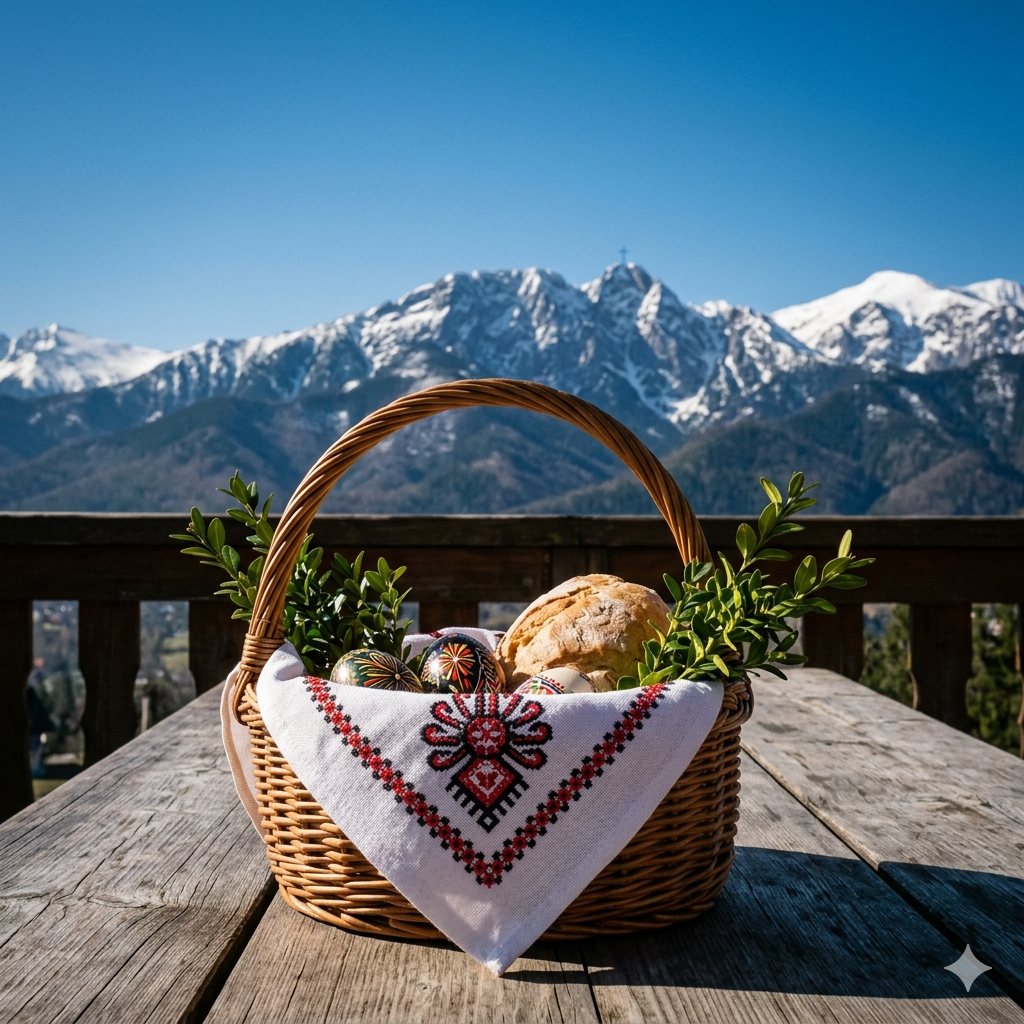
The heart of the preparations is the “Kosełecka”—the regional Easter basket, which must look magnificent. You won’t find random products inside; every element has its place.
- Butter Lamb: The mandatory symbol of the Resurrection.
- Regional Oscypek: The smoked cheese that is the pride of the Highland pastures.
- Moskol: A traditional griddle cake that adds an authentic pastoral character.
- Horseradish and Salt: To ensure the health of the household.
Holy Saturday Magic: Blessing Fire, Tinder, and Water
On Holy Saturday, fire takes center stage. Large bonfires are lit in front of churches, from which the faithful light tree tinder (huba) brought from the forest. This blessed fire is then taken home to light the hearth and bring God’s blessing to the family.
The ritual of “blessing the spirit”—lighting the tinder—requires walking around the entire farmstead three times while praying (Source: rabkoland.pl). The smoke from the smoldering tinder is believed to purify the space and protect the home from misfortune.
Highland Celebrations: Regional "Sodra" and the Rules of "Polewacka"
When the church bells ring for the Resurrection on Easter morning, all of Podhale wakes up to a joyful atmosphere. The strict fast is forgotten, and homes fill with the scents we have waited weeks for.
Easter Breakfast: The Shared Bowl and Traditional "Chrzanówka"
Breakfast in Podhale is a ritual of unity centered around one shared bowl. From it, all family members take “krajanka”—diced ingredients from the blessed basket: meats, eggs, cheese, and horseradish. This custom of eating from a single dish reminds the family to always stick together. The true queen of the table, however, is sodra (also known as chrzanówka) — a thick, hearty soup made from whey, bacon, and a generous amount of grated horseradish. It must be sharp, substantial, and truly "Highland" in style.
Sunday Taboos: Why You Must Not Cook or Clean
Easter Sunday in Podhale is a day of absolute peace. Tradition dictates that one should neither cook nor clean. Even combing one’s hair or napping during the day was once forbidden, lest it invite laziness or misfortune. It is a time reserved exclusively for family, conversation, and singing.
Easter Monday: "Polewacka" and Egg Ransoms
The atmosphere shifts on Easter Monday with the lively “polewacka” (the dousing of water). In Podhale, soaking someone with water was never just a game—it was an ancient rite to ensure health and vigor, especially for young women. To avoid a total soaking, girls “buy” their way out by offering beautifully decorated Easter eggs (pisanki).
FAQ: Quick Facts about Podhale Easter
- What is Sodra? A traditional Easter soup based on whey or sour milk, served with horseradish and diced meats from the Easter basket.
- Why bless tree tinder (huba)? To bring the “blessed fire” home, purifying the farm and protecting it from evil.
- Who are the Pucheroki? Caroling boys in tall straw hats. While typical of the Krakow region, their influence is sometimes seen in parts of Podhale.
- Where to see unique decorations? The Ethnographic Museum in Krakow holds the largest collection of pisanki in Poland and unique palms from Rabka-Zdrój.
- Is egg painting new? No, the oldest pisanki found in Poland date back to the 10th century.
Rules for Easter rest in Podhale – what is worth knowing?
- Easter Sunday: A day of absolute peace; traditionally, people avoid cleaning and even combing their hair.
- No cooking: All dishes, including the regional sodra, are prepared in advance so that Sunday is devoted only to feasting.
- Three processions: The faithful walk around the church three times, which is believed to protect the whole community (Source: willatatiana.pl).
- Wet Monday: A joyful day of splashing water, when unmarried women would “buy themselves off” with decorated Easter eggs.