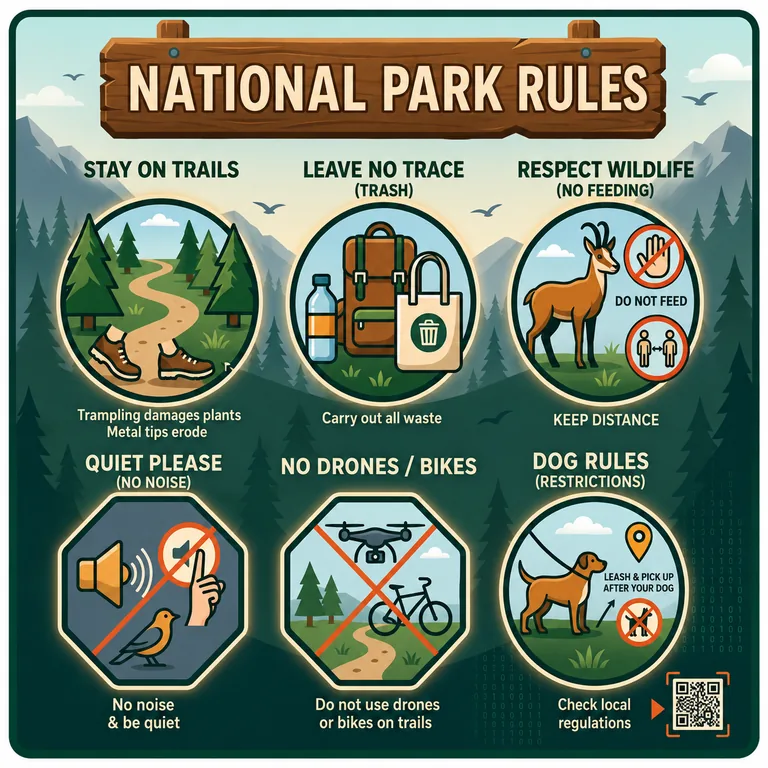
National Park Rules: A Complete Guide to Regulations and Etiquette.
A lack of familiarity with local rules is the fastest way to turn your first mountain expedition into a heavy fine rather than a collection of souvenir photos. Every National Park has its own specific prohibitions, and statistics show that a lack of basic knowledge regarding regulations generates the most costly penalties on the trail.
Why Are National Park Rules So Strict? (Ecology and Science)
A fine is just the tip of the iceberg. The true price of ignorance is much higher, and it is paid by nature, which cannot defend itself against human expansion. Strict National Park rules do not exist to limit our freedom, but to protect what is most precious.
The Impact of Noise and Trampling on the Ecosystem
Every step taken off the designated trail is a “micro-catastrophe” for the soil. Trampling destroys the structure of the ground, making the earth compacted, which prevents plants from germinating and regenerating. In high mountain areas, where the growing season lasts only a few weeks, these losses are often irreversible.
In Tatra National Park (TPN), particularly congested points like the road to Morskie Oko (over 1.1 million entries in 2025) or the Kościeliska Valley (656,000 entries) face immense pressure. For context, 2025 went down in the history of Polish nature conservation as a year of absolute attendance records. TPN was visited by exactly 5,266,672 tourists. In the peak month of August 2025 alone, 1,097,653 people hit the Tatra trails, with 237,000 reaching Morskie Oko.
This phenomenon leads to “bottlenecks,” resulting in the physical degradation of trail surfaces and the destruction of vegetation adjacent to paths by people trying to bypass congestion. Such traffic intensity requires constant monitoring and expensive infrastructure maintenance.
Pro-tip: If you want to avoid the crowds, check out our blog post: “Unknown Spots in Podhale: Hidden Gems Away from the Crowds”, where you’ll find tips on spots in the Tatras that offer breathtaking views similar to Morskie Oko but without the “traffic jams.”
Noise and the "Landscape of Fear"
Noise acts on the ecosystem like an invisible barrier, disrupting the natural rhythm of life and forcing animals to abandon safe feeding grounds. Piercing sounds scare birds during nesting season, often leading to nest abandonment. The regeneration of a trampled patch of high-mountain vegetation can take decades—or even centuries (Source: Tatra National Park).
Staying on designated paths is the foundation for the survival of local flora and fauna. When we wander off-trail, we alter the microclimate and open the door for invasive species.
Animal Stress and Human Presence
The mountains are the home of wild inhabitants; we are merely guests. Our scent, bright clothing, and loud conversations create a state of chronic threat for animals. Even if you don’t see an animal fleeing, its body enters a high-energy “survival mode” that weakens its immune system.
Studies show that stress hormone levels in chamois living near busy trails are drastically higher than those in remote areas. This is why rules regarding dog bans or movement after dark are crucial for their physical survival. A tired animal that must flee from a tourist instead of resting may simply not survive the coming winter.
The National Park as a "Nature Museum" and Heritage
Drony są dla wielu gatunków ptaków postrzegane jako groźne powietrzne drapieżniki. Ich obecność wywołuje panikę i ogromny stres u zwierząt, dla których skalne ściany są jedynym schronieniem. Prawo lotnicze utrzymuje rygorystyczne zakazy lotów nad parkami narodowymi, a dyrekcje parków dopuszczają loty jedynie w wyjątkowych przypadkach po uzyskaniu indywidualnej zgody, zazwyczaj do celów naukowych lub ratowniczych
Pamiętaj, że głośne rozmowy czy muzyka z głośnika to dla nich sygnał o nadchodzącym zagrożeniu. Wyłączenie telefonu i powstrzymanie się od triumfalnego krzyku na szczycie to najprostszy prezent, jaki możemy dać górom.
Rower na szlaku pieszym to nie tylko kwestia bezpieczeństwa, ale też dodatkowej erozji podłoża. Opony niszczą wierzchnią warstwę gleby, przyspieszając degradację ścieżek. Opony rowerowe, szczególnie przy hamowaniu lub podjazdach, generują znacznie siły ścinające powierzchnię co przyspiesza proces żłobienia rynien erozyjnych na szlakach górskich. Z tego powodu ruch rowerowy jest w parkach ściśle limitowany do wyznaczonych tras o odpowiednio utwardzonej nawierzchni.
The National Park as a "Nature Museum" and Heritage
A National Park is a specific kind of museum where the exhibit is nature itself in its purest, undisturbed form. Here, we don’t “improve” the forest or clean it up; we let dead trees become homes for thousands of organisms. We protect natural processes that have unfolded for centuries without human interference.
How our daily habits clash with conservation:
- Leaving an apple core: It seems harmless, but it introduces foreign organic matter and teaches animals to beg.
- Shouting at the summit: For animal hearing, this is a source of intense fear.
- Building stone stacks (cairns): This destroys micro-habitats for insects and mosses living under those stones and leaves a human footprint on a wild environment.
Drones, Bikes, and Silence: Technology vs. Nature
Drones are perceived by many bird species as dangerous aerial predators. Their presence causes panic and immense stress. Aviation law maintains strict bans on flights over National Parks. Permits are only granted in exceptional cases (scientific research or rescue operations).
Bicycles on pedestrian trails aren’t just a safety issue; they cause soil erosion. Tires destroy the top layer of soil, especially during braking or climbing, creating “erosion gullies.” Therefore, cycling is strictly limited to designated routes with appropriately hardened surfaces.
Practical Preparation: Tickets, Dogs, and Gear in 2026
Planning a trip in 2026 involves more than just checking the weather; it requires a quick session on your smartphone. Digitalization has hit the trails for good, meaning fewer queues at wooden booths.
Important Note: The online parking reservation system is now mandatory for high-traffic spots like Palenica Białczańska (the start of the Morskie Oko trail). Failure to have an e-ticket is the most common cause of fines and conflicts at park entrances.
Admission Fees and E-Tickets
Paper tickets are becoming a thing of the past, replaced by QR codes and mobile apps.
Ticket Type | Approx. Price (2026) | Notes |
Standard 1-Day | 10 – 16 PLN | Depends on park popularity |
Discounted 1-Day | 5 – 8 PLN | Students and Seniors |
Large Family Card | 0 PLN / 50% off | Verification via mObywatel app |
Hiking with Dogs: Rules and Exceptions
In most Polish National Parks, there is a total ban on dogs, even on a leash. Your pet is a family member to you, but to a deer or a marmot, it is a predator.
If you are planning a trip with your four-legged friend, your options are limited:
- Karkonosze National Park: The most liberal; approx. 97 km of trails are open to dogs on a leash (including Śnieżka).
- Wigry National Park: Dogs allowed on a leash on most trails in landscape protection areas.
- Ojców National Park: Dogs are welcome on a leash (e.g., Sąspowska and Prądnik Valleys).
- Tatra National Park (TPN): Total ban almost everywhere. Exceptions: Only the bottom of the Chochołowska Valley and the Droga pod Reglami.
- Bieszczady, Pieniny, Słowiński, etc.: Bans are generally in effect on most or all territory.
Note: The fine for bringing a dog in violation of the rules typically ranges from 50 to 500 PLN.
Gear Essentials: From Trash Bags to Trekking Poles
Your gear dictates the footprint you leave behind.
- Trekking Pole Tips: While the sound of metal on stone is annoying, TPN guides recommend removing rubber tips on rocky surfaces (granite/limestone) to prevent slipping and to stop lost rubber tips from becoming synthetic waste. However, on softer ground, metal tips accelerate erosion. Choose your tips based on the terrain.
- Trash Bags: You won’t find bins on the trails. Bins attract animals and teach them to beg. Everything you bring in—including banana peels—must leave with you.
FAQ – Frequently Asked Questions
What are the penalties for breaking rules?
National Park Rangers have the authority to ID you, issue fines, or even refer cases to court.
- Off-trail hiking: 50 – 500 PLN fine.
- Illegal camping: Fine or court summons.
- Destroying vegetation: High fines determined individually.
Can I drink alcohol or smoke?
Consuming alcohol in public areas (the entire park) is prohibited. Smoking is a major fire hazard.
New for 2026: As of January 2, 2026, smoking outside designated areas in forests and National Parks can result in a fine of up to 5,000 PLN, or up to 30,000 PLN if the case goes to court, due to increasing drought risks.
What should I do if I encounter a wild animal?
Do not approach or feed it. If the animal notices you, do not run. Back away slowly the way you came. Speaking calmly or humming is usually enough to let the animal know you are there so it can move away (Source: Tatra National Park).
By following these rules, we ensure that the mountains remain a sanctuary for nature and a beautiful destination for future generations. Be a guest the mountains can be proud of.